 For those who love this genre. Pass on through this link:
 Terror Funds There
find some images that may please them
 For those who love this genre. Pass on through this link:


MAGIC AND SCIENCE
THE MAGIC AND THE CHURCH
 For the Church, the miracle that had mastered the art of magic was particularly dangerous, because the common people could easily take a saint. The Church faced a very serious danger, as many saints appeared false preaching, prophesying and gathered around them to ensure that many people were Jesus Christ. The people gladly followed those figures look doubtful because he aspired to the divine and the human figure. And that was precisely what they promised these people, which combined the traits of Christian and pagan sorcerers. This reopened the door to the old pagan beliefs, with their cults and magical ceremonies, which were still alive in the population and that the Church was trying to condemn to oblivion. There must expose the false saints in real competitions magia.Este topic extensively in the literature religion of the Middle Ages, is based on the model of the New Testament Apocrypha, which speaks of the competition between Peter and Simon Magus and tells how Peter managed with prayers by Simon had just hit the ground during one of his usual magic flight.
 THE MAGIC OF PRIESTS
 After his death, many legends were woven around his supposed power over demons. So, saying that by a trick he pulled a philosopher a magic book which listed all the arts were secret. When the philosopher was about to find out, he swore allegiance to the devil if he saved from his pursuer. This happened, and thanks to the devil Gerbert made an impressive career. To predict the future, the devil gave him a bronze head that answered all questions with "yes" or "no". In the stories that revolve around mixing Gebert d'Aurillac many legends of magical literature . Thus, talking head used for divination was known in much older traditions: for example, the head of Bran in ancient Irish literature or of Mimir among the Germans.
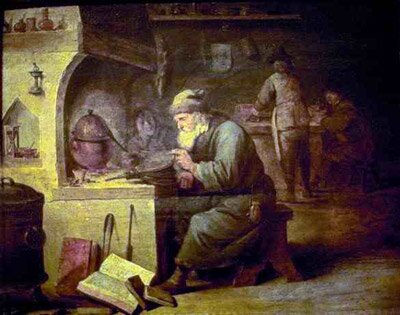
  If at first explaining the mysterious ties especially in the theoretical, from the thirteenth century began address experimentally. The experimental magic enjoyed a boom especially in alchemy. The results of the experiments were recorded for the finds of the occult could be transmitted more easily to the fans or aspiring to the status of insiders. To ward off the threats of the Inquisition, but also to satisfy the aspiration own "esoteric" languages \u200b\u200bwere developed especially secretos.Sobre alchemy devised a hermetic language rich in symbols and images alegóricas.En circumlocution later centuries, this secret language was the cause of which developed the great prestige of this art among natural scientists, it seemed demonstrate that truth, and undoubtedly transmitting an occult science, at least so it seemed, was not easy to penetrate.
 From a broader perspective, magic designates the metaphysical beliefs, whose central and distinctive element is the human capacity to change reality without means strictly causal. The magic in general is also often referred to as witchcraft. Many modern inventions are magic to primitive societies, and supplement the capabilities sought by the ancient wizards.
Studies magical thinking:
However, it should be stressed that the current use of words (language) for changes in a person, sometimes even without your knowledge, is the basis for many psychotherapies, including psychoanalysis. Also, the use of techniques such as suggestion, hypnosis and NLP neurolinguistic programming, and even placebos, are tools of behavioral change that in ancient times could be attributed to charms, spells, witchcraft, magic, or miracles in the case of religion. We should also mention the known effects of self-fulfilling prophecy in which a statement about the future, in the form of prophecy, unleashing a series of events that end up causing what had been predicted. The difference of these techniques with magic, is the lack of empowerment of spiritual or metaphysical entities.
On the other hand, the magic word is also used to refer to phenomena that have no explanation rational. The inexplicable can be "magical." Sometimes to refer to feelings like love, happiness, when there is something you can not define "no magic."
History
The term derives from magi magic, one of the religious elements incorporated by the wise men in ancient Babylon. There were wizards in Rome, Greece and almost all the Western and Eastern antiquity, when folk magic or sorcery were related to ancient fertility rites and initiation into the knowledge of the people called barbarians, especially the Chinese.
The magic and witchcraft were linked also to the beliefs of peoples ancient East, in which the magician or witch was both a healer and a knower of the unseen world of spirits and played a leading role in the community.
In Greece and Rome, the soothsayers and magicians no longer had anything to do with shamans, although they were consulted on all the powers of divination which were believed to be gifted.
In medieval Europe, magic was associated with alchemy and astrology, demonic occult activities considered by the Catholic Church and were persecuted, especially during the late Middle Ages and the Modern Era. Some 500,000 people were tried and executed largely by civilian courts and religious leaders, accused of witchcraft, over nearly five centuries. There was witchcraft trials until the nineteenth century, both in Europe and North America. In Europe, the Tribunal of the Inquisition developed a role in these events. It should be noted that none of the major religions accept the magic, no other Christian faiths. In regard to Judeo-Christian religions in particular, are already negative references to the wizards in the Old and New Testaments.
Secrecy (called the ancient science in the Middle Ages) influenced Renaissance thought. This pseudoscience is linked, in some respects, to the maintenance of old beliefs, like magic, leading to the understanding and management of the spiritual laws of the universe. In 1463, Cosimo de 'Medici commissioned translation of the work of Hermes Trismegistus, supposedly written in ancient Egypt but, for many, dating from the early centuries of the Christian era and is the cornerstone of the Hermetic or Gnostic movement (from gnosis, knowledge).
divination through tarot was a frequent activity in the birth of the modern era symbols and systems developed by the fortuneteller for understanding the present situation and future are clearly indebted to other methods of divination practiced by magicians, including reading the flight of birds and the entrails of slaughtered animals.
simple practices witchcraft, divination, astrology, reading books and oracle decks as the ancient I Ching, the Chinese, or the Scandinavian runic alphabet, aspects of Hinduism, yoga and even the belief in the divinity of extraterrestrial civilizations and their presence among humans formed since the mid-twentieth century a cluster weakly articulated what became known as the New Age movement (in English New Age).
Magic has been persecuted in history (for religious or social currents) and, even today, contrasting his theories through the scientific method, but in other times would have meant death to the magician.
Magic in Symbolic Anthropology
as Frazer Magic
Urarina Shaman of the tribe, 1988.Según Frazer, the thinking that underpins the concept of magic is a set of practices and beliefs to which individuals in a society resort to create a benefit or an end, relating to his time in a certain order in nature, either as a group, when a natural limitation severely affects the social organization of it (a drought or infertility) (witchcraft), or individual level, when required, for example, get rid of an enemy that threatens the life (taboo).
Los evolucionistas distinguieron notablemente las profesiones públicas bajo las que se constituía una u otra sociedad;
Representó un punto medular en los estudios que trataron de comprender la organización de sociedades no occidentales que contrastaban con las occidentales. Se puede dividir en dos aspects of analysis, mental processes, according to abstract principles that underpin the practice of magic under a law called empathy.
is for this reason that in this line of thought is the predecessor of magic to religion in an evolutionary scale, ie the magic corresponds to a stage in evolution of certain companies that are considered wild and religion to others will assume a higher degree of civilization. Therein lies the interest of his study, which sought to understand the point that ceases to be magic to become a religion and thus make social progress to another stage of evolution. Frazer
understands the magic as the expression of rules that determine the achievement of events around the world, like magic theory, and regarded as a set of rules that humans meet in order to achieve its goals, and practical magic. This is divided into two types, each of them is based on the principles of similarity and contact:
is relevant to mention the consequence of colonial of fusion, which is not only racial manner, as addressed in the biological standpoint, but above all respond to the socio-cultural exchange. As an example we can take the call Santeria, in general terms, is considered as a set of component elements of Catholicism and Yoruba traditions imported by slaves captured in Nigeria and moved to Cuba.
This combination of religious systems is still practiced to this day in various parts of Latin America, and is governed not only by devotion to the saints identified with the orishas, \u200b\u200bbut involves a priestly hierarchy. A clear example is when the magic contaminant for the initiation of a priest, he is given a certain amount of collars during the rite, which allow you to represent a certain amount of orishas and keep in touch with them through the sacrifice of goats or other animal. These beliefs and practices also mean that the resolution of certain problems, how to restore health to someone who asked, are due to be summoned the spirit of their ancestors and took the offering to the orisha indicated. This is sympathetic magic and animistic beliefs imply.
The transition from magic to religion
Frazer believes that the principles of association of ideas wrongly applied produce the magic, which even considered as "bastard sister of science." [citation needed] Frazer believes that the first strike that transformed mankind to abandon magic as a rule of faith and practice, was to recognize "the inability to manage a pleasure certain natural forces which hitherto had been assumed within its mandate. "[citation needed] In this conception we can understand that the intelligence of the men began to perceive that the practice of magic is not produced exactly the expected results, which previously meant a reality. This was continued for a long period of reflective thought that made the transition to religion Gradually, by the better understanding of the forces with a higher power of man and the development of knowledge. Frazer concludes that the final step of magic to religion is given in "the confession of the entire and absolute dependence of man in relation to the divine ', culminating in the submission of man before the immensity of the universe.
Currently, however, it is considered impracticable to establish an emphatic boundary between magic and religion, much less in a unilineal evolutionary premise as that proposed by Frazer. This is the case of Mesopotamian culture, where religion and magic coexist within the social body to the point of being indistinguishable.
Magic Systems
anthropology distinguishes traditional witchcraft of the first societies. It has drawn many synchretisms
Brujeria is the simplest form of magic practiced in ancient societies. It is based on the manipulation of matter and the analogy. The wizard uses potions fetish, animals and different objects to achieve their ends. In his old home the word pharmacy, pharmakia Greek, referring to the preparation of potions and poisons. He went to the current use of auxiliary medicine, pharmakon, medicine. 


Classic Magic, Theosophy and New
 The magic is rooted in contemporary on work initiated as Eliphas Levi and Papus. Theosophy, Theosophy and the modern, is one of its founders Helena Petrovna Blavatsky, who was looking to the east the source of his philosophical system. This system does not show exactly how the systems used by students of magic, even more, intended to convey the universal esoteric knowledge that would be contained in all philosophical and religious traditions. Blavatsky considers, for example, that all men are wizards in the final sense of the word, because everyone can use the divine creative power, either through thought, word or action.
 sexual magic
 this topic are grouped into different sets: Thelemite, Gnostic, etc.., Which certainly must be differentiated from the Tantra which has a few points of connection. The base of these systems is the concept that sex is sacred.
Sexual magic is divided into several different systems and differences, some of them derived from the system originally developed by Paschal Beverly Randolph and later by Theodor Reuss in the Ordo Templi Orientis (OTO) and Aleister Crowley, by Kenneth Grant and the artist Austin Osman Spare. We cite among the various systems of sexual magic:
Thelema
Philosophy, Religion or Religion, depending on your point of view, created by Aleister Crowley from Liber AL vel Legis (Book of the Law). Upon receipt of this book began a new era, Aeon of Horus, where man is seen as the center of his universe. Thelema Greek means will.
Samael Aun Weor
WeorEl Samael Aun Colombian Victor Manuel Gómez R. (Samael), founder of the Universal Christian Gnostic Movement, taking sexual magic as one of the pillars of what he called "revolution of consciousness." Its main feature is what the author calls' revolutionary ascetic of the Age of Aquarius. " According to the author, metaphysically, the process is "intelligent mix of sexual desire with spiritual enthusiasm," this is, in short, the connection of male and female genitalia called by ionizing and lingam terms (in Sanskrit), avoiding orgasm, both male and female, loss of semen and transmuting, through processes outlined in his books, the semen in energy, light and consciousness.
Ordo Templi Orentis
The Ordo Templi Orientis, founded by Theodor Reuss and Karl Kellner at the beginning of the twentieth century was initially based on the implementation of sexual tantra with a structure resembling the masonry. When the English occultist Aleister Crowley, was admitted to the Order, its rituals and basic philosophy were reformulated to be interpreted and worked under the so-called law of Thelema. The OTO ended up being the origin of various dissident who took different views on magic. Among the disagreements that make a work of serious consideration can include the Ordo Templi Orientis Antiqua (autumn) and Tifoniana Ordo Templi Orientis (OTO Typhonyan or TOTO). Magic
luciferic
Saturni System. It is a system similar to that of OTO, centralizing their sexual magic practices (especially in the practices of "path on the left) and ritualistic magic. The main difference from the OTO is that while the individual seeks to merge with the creative energy, as central idea, the Fraternitas Saturni aims to raise human spirit to a divine status, represented by Lucifer. The system has 33 degrees. Magic
Enochian Magic Enochian is a complex symbolic system, which consists in the evocation of angels enokianos, discovered by the astrologer John Dee and his seer Edward Kelley. The system was subsequently studied by the Golden Dawn Golden Dawn and Aleister Crowley.
musical magic
Created by a renowned occultist, Juanita Wescott, who has studied the system of Franz Bardon. The musical magic system makes use of Hermeticism and Kabbalah.

 The oldest data on the remote magic the magician Dedi, as the papyrus found in an ancient Egyptian tomb and subsequently translated. Dedi lived during the reign of Khufru, (also known as Cheops), Pharaoh of Egypt who was the builder of the Great Pyramid of Giza.


