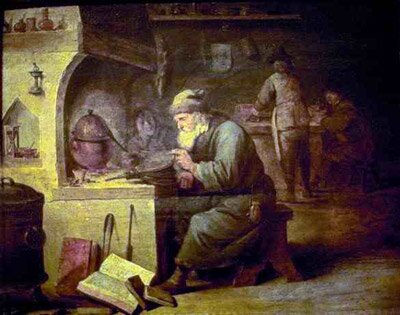
During the Middle Ages one encountered everywhere in the ancient magical traditions from classical antiquity, but not only this, but also to popular belief characteristic of different population groups, such as the Celts, Teutons or the Gauls. Even the Hebrew and Arab traditions exerted a great influence those ideas were not in vain widespread secret doctrine of the Jews, Kabbalah, and astral magic and talismanic Arabs. Magic and science were not yet divorced, and many still unexplained natural effects were associated with magic.
MAGIC AND SCIENCE
In medieval times, magic was considered a science: they talked about the arts or arts magicae incertae, but were forbidden arts. The term "art" meant both as a science. But the magicians were not only those who claimed themselves to be special skills and powers help of the forbidden arts, but rather the scholars in the development process of the natural sciences had to use his scientific experiments in the magical arts. So often came into conflict with the Church and especially the Inquisition.
THE MAGIC AND THE CHURCH
A mages spells are attributed deceased and the ability to master the elements. They practiced different techniques without success mantic (divination) as the magic mirror and dream divination. Also, the possession by the devil and the pathological and obituary spells were associated with wizards. To escape the persecution of the Church the magic is searching for new spaces within the religious world. Since the Christianization of the pagans, liturgy and church rituals increasingly absorbed ideas and actions that were considered characteristic of the magic.
SANTOS MEN AGAINST
The process in which the Church fought to gradually monopolize the supernatural, the Christian saints were eventually rival magicians.  For the Church, the miracle that had mastered the art of magic was particularly dangerous, because the common people could easily take a saint. The Church faced a very serious danger, as many saints appeared false preaching, prophesying and gathered around them to ensure that many people were Jesus Christ. The people gladly followed those figures look doubtful because he aspired to the divine and the human figure. And that was precisely what they promised these people, which combined the traits of Christian and pagan sorcerers. This reopened the door to the old pagan beliefs, with their cults and magical ceremonies, which were still alive in the population and that the Church was trying to condemn to oblivion. There must expose the false saints in real competitions magia.Este topic extensively in the literature religion of the Middle Ages, is based on the model of the New Testament Apocrypha, which speaks of the competition between Peter and Simon Magus and tells how Peter managed with prayers by Simon had just hit the ground during one of his usual magic flight.
 For the Church, the miracle that had mastered the art of magic was particularly dangerous, because the common people could easily take a saint. The Church faced a very serious danger, as many saints appeared false preaching, prophesying and gathered around them to ensure that many people were Jesus Christ. The people gladly followed those figures look doubtful because he aspired to the divine and the human figure. And that was precisely what they promised these people, which combined the traits of Christian and pagan sorcerers. This reopened the door to the old pagan beliefs, with their cults and magical ceremonies, which were still alive in the population and that the Church was trying to condemn to oblivion. There must expose the false saints in real competitions magia.Este topic extensively in the literature religion of the Middle Ages, is based on the model of the New Testament Apocrypha, which speaks of the competition between Peter and Simon Magus and tells how Peter managed with prayers by Simon had just hit the ground during one of his usual magic flight.
 THE MAGIC OF PRIESTS
In the Christian Church, the Bible and psalms were handled as if they were magical texts, medals of saints served as amulets, relics replaced the fetishes, representations of God acted as idols and from the Bible and the psalms were composed true books of magic and magic formulas. Exorcists psalms and formulas used in the Bible to cast out demons. With the symbol of the cross, sprinkled with holy water and the host is adminitración ward off evil espíritus.Un particularly complex area was the magic of the priests, when they managed to go a priest to exorcise a possessed, showed that the priest exercised his power over demons. Magicians also said that they had power over demons who chase the demons knew, could also summon. It's the same picture ambivalent shamanism is known: the sorcerer can cure, but also captivated, you can use her magic to heal the sick or for healthy ill or dying. The priests sorcerers could be subject to the same suspicions.
THE CASE OF WILD II
In the Middle Ages, even the potatoes using magic. Gerbert d'Aurillac, who was later Pope Sylvester II (999-1003), there were the strangest things.  After his death, many legends were woven around his supposed power over demons. So, saying that by a trick he pulled a philosopher a magic book which listed all the arts were secret. When the philosopher was about to find out, he swore allegiance to the devil if he saved from his pursuer. This happened, and thanks to the devil Gerbert made an impressive career. To predict the future, the devil gave him a bronze head that answered all questions with "yes" or "no". In the stories that revolve around mixing Gebert d'Aurillac many legends of magical literature . Thus, talking head used for divination was known in much older traditions: for example, the head of Bran in ancient Irish literature or of Mimir among the Germans.
 After his death, many legends were woven around his supposed power over demons. So, saying that by a trick he pulled a philosopher a magic book which listed all the arts were secret. When the philosopher was about to find out, he swore allegiance to the devil if he saved from his pursuer. This happened, and thanks to the devil Gerbert made an impressive career. To predict the future, the devil gave him a bronze head that answered all questions with "yes" or "no". In the stories that revolve around mixing Gebert d'Aurillac many legends of magical literature . Thus, talking head used for divination was known in much older traditions: for example, the head of Bran in ancient Irish literature or of Mimir among the Germans.
 ARABIC INFLUENCE
played in medieval magic an important role in the influence of the East, especially Saudi. As for the Arabs also the magic part, along with alchemy, the art of divination and astrology, natural science, as such scholarship came to the study centers of medieval Europe. Many Arabic texts commenting on the various forms of magic. One of those books in the sciences greatly influenced sealed until the time of the Renaissance: it's called Picatrix (Arabic: al-hakim Ghayat), which holds that human beings can transform one's self with the help of science magic, and especially of words, language and formulas. Thus, the human being as intermediate institution could evolve into higher forms or lower. According to the Picatrix, magical knowledge comprises three branches: the knowledge of the talismans of the planets and the spells. Astrological constellations understood as transmitters of the celestial forms originate. The mission of the magician consisted of moving the astral matter how desired by the party of certain stars and constellations. Thus talismans were produced, in which both the metals used to manufacture them as signs that were recorded in them correspond to the spiritual being allocated to each celestial body whose energy and wanted to take the human being. The magician tried also bring down those forces to a certain place to fix it. As spiritual beings personified demons appeared, the magician conjured up for them at your service. The Picatrix, where converged astrology and ceremonial magic, enjoyed great prestige among the scholars of the Middle Ages, recognition that went to the Renaissance.
Secret Language
During the course of the Middle Ages, magic scholarly circles became a branch of science.  If at first explaining the mysterious ties especially in the theoretical, from the thirteenth century began address experimentally. The experimental magic enjoyed a boom especially in alchemy. The results of the experiments were recorded for the finds of the occult could be transmitted more easily to the fans or aspiring to the status of insiders. To ward off the threats of the Inquisition, but also to satisfy the aspiration own "esoteric" languages \u200b\u200bwere developed especially secretos.Sobre alchemy devised a hermetic language rich in symbols and images alegóricas.En circumlocution later centuries, this secret language was the cause of which developed the great prestige of this art among natural scientists, it seemed demonstrate that truth, and undoubtedly transmitting an occult science, at least so it seemed, was not easy to penetrate.
 If at first explaining the mysterious ties especially in the theoretical, from the thirteenth century began address experimentally. The experimental magic enjoyed a boom especially in alchemy. The results of the experiments were recorded for the finds of the occult could be transmitted more easily to the fans or aspiring to the status of insiders. To ward off the threats of the Inquisition, but also to satisfy the aspiration own "esoteric" languages \u200b\u200bwere developed especially secretos.Sobre alchemy devised a hermetic language rich in symbols and images alegóricas.En circumlocution later centuries, this secret language was the cause of which developed the great prestige of this art among natural scientists, it seemed demonstrate that truth, and undoubtedly transmitting an occult science, at least so it seemed, was not easy to penetrate.


0 comments:
Post a Comment